
One operating system for the whole practice
Most clinics run an EMR, a CRM, a phone system, a texting tool and a payment terminal side by side. Natkiva is a Medical Practice Operating System: it does all of that as one system, around one record of each patient. Physician-designed, for independent clinics.
Eleven parts. One record of each patient.
Most clinics run five systems from five vendors: a chart, a scheduler, a phone system, a texting tool and a payment terminal, with five logins and five copies of each patient. The gaps between them are where the day's problems come from. Natkiva is those five things as one system with one record of each patient. This page explains what each part does and why having them together matters. It is built and tested inside R2 Medical Clinic in Denver.
The whole platform at a glance
Everyone in the clinic and the modules the clinic chooses, around one record of each patient.
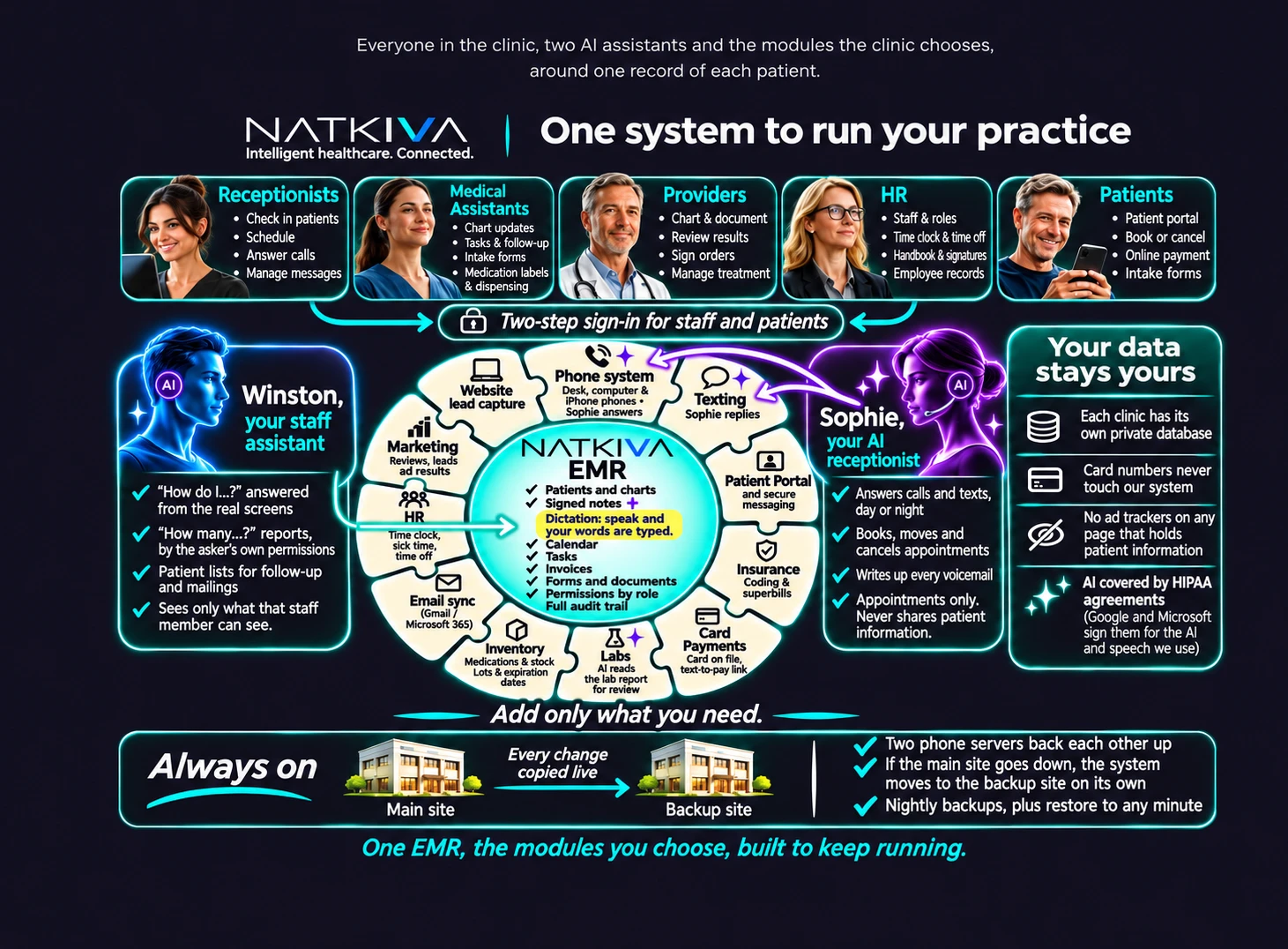
Explore each part
Click any part to see what it does for the clinic.
What each one does
The chart (in place of an EMR)
The patient chart: progress and chart notes that are signed and locked, labs, prescriptions, documents, consent forms and treatment plans on one page. Notes can be dictated, and a patient’s whole record exports in standard formats whenever it is needed.
Leads and follow-up (in place of a CRM)
Every new inquiry, from the website, an ad, a call or a text, becomes a lead with an owner and a next step until it is booked or closed. Follow-ups after missed and cancelled visits, review requests and email campaigns keep patients coming back.
Phones
The clinic’s numbers ring in the app with the caller’s record open. Greetings follow the clinic’s hours, every voicemail is transcribed, and calls can be held and forwarded. Patients who only want to book or move a visit may use the optional External AI Agent instead of waiting, which leaves the desk free for the calls that need a person.
Text messaging
Two-way texting with patients who agreed to it. Reminders and follow-ups go out on the clinic’s rules, and patients reschedule, cancel or book from a private link or by replying to a text.
Payments and billing
Invoices, card on file with the patient’s consent, pay-by-text links and memberships, every payment posted to the patient’s record. A card surcharge, where the clinic uses one, goes on credit cards only.
Secure messaging
Staff message each other, and patients message the clinic through the portal instead of email. Documents and lab results reach the patient only when someone chooses to share them.
Patient portal
Patients see their visits, book, pay, read shared documents and message the clinic from their own secure login.
Clinic operations
The time clock, time off, employee records and the handbook, and inventory with lots, expiration dates and a controlled-substance log.
Optional AI agents
An External AI Agent patients may choose to book, move or cancel appointments by phone or text: an adjunct to the receptionist that takes routine calls off the desk, without hiring more people. And an Internal AI Agent that answers staff questions with each person’s own permissions. Nothing enters the chart without a signature.
A booking by text, one question at a time
For a patient who chooses the External AI Agent, the booking is a few short questions answered by number or in words. They see only times that are really open, nothing is booked until they say yes, and the appointment lands on the calendar like any other: one less call for the desk.
A real test conversation with the External AI Agent, Oct 15, 2026. Every line is the clinic’s own wording.
Each gap closed, and the effects compound
Streamlines day-to-day operations
One login and one record. A call, a text and a visit update the same schedule and the same chart. Nothing is re-keyed from one screen into another, nobody checks three places to answer one question, and everyone works from one queue of things that actually need a person.
Increases efficiency
The routine work runs itself: confirmations, reminders, rescheduling, cancellations, call-back requests and the tasks that follow a missed visit. Staff time goes to the patients in the room and to the exceptions, instead of to the phone queue and the reminder list.
Reduces waste
Fewer empty slots, because reminders go out on time and rescheduling is a text away. Fewer errors, because there is one copy of each patient. Fewer vendor fees, fewer integrations to maintain and fewer hours lost when one of them breaks.
Improves patient communication and retention
Patients can change an appointment from a text, the portal or, where the clinic offers it, the External AI Agent, without waiting on hold, and the calls that do reach the desk get a person with time to talk. The clinic knows when a patient was last heard from, follows up after a missed or cancelled visit, and asks for a review or says thank you at the right moment. Patients who are easy to reach and easy to reschedule keep coming back.
Reduces loss of new patient inquiries
Every inquiry, from a call, a text, the website or an ad, becomes a lead with an owner and a next step, so it is followed up the same day instead of lost between a voicemail and a notepad. Where the clinic offers the External AI Agent, a new patient calling after hours can book a first visit then and there.
Which all lead to improved revenue
Fewer missed inquiries become more new patients. Fewer no-shows and faster rescheduling keep the schedule full. Payment by text link shortens the time between a visit and the money arriving. Lower overhead comes from fewer vendors and less staff time on routine work. None of these is a trick; each is a leak closed, and the clinic keeps what used to drain away.
Built from inside a working clinic
Natkiva was designed by Erik Natkin, DO, the physician who owns R2 Medical Clinic, from inside the clinic rather than from a software company's view of one. The order of the questions a patient is asked, the way a day's locations and providers are checked before a time is offered, what the assistant may and may not do, how a missed visit is followed up: each of these is a decision a physician made about how a clinic should run. He still owns and runs the clinic, so he lives with the results of every one of those decisions. It is built with software engineer Matthew Montez, and R2 Medical Clinic’s own staff help test it and shape what comes next.
Natkiva brings it together
As a Medical Practice Operating System, Natkiva brings the patient chart, patient relationships, communications, scheduling and billing together in one seamless platform. By eliminating disconnected systems, automating repetitive tasks, and improving patient engagement, Natkiva helps medical practices operate more efficiently, reduce unnecessary expenses, capture more patient opportunities, and ultimately improve profitability while delivering a better patient experience.
How it is sold
- One subscription covers the core: the chart, scheduling, leads and follow-up.
- Phones, texting, payments, the AI agents and the other modules are switched on for each clinic as it needs them.
- Texts, call minutes and AI conversations are priced by use.
- Each clinic gets its own database and its own web address.
Get in touch for pricing.